World Physiotherapy Taipei principles for the responsible use of AI in physiotherapy
World Physiotherapy has developed a set of guiding principles to support the safe, ethical, and responsible use of artificial intelligence (AI) in physiotherapy.
The World Physiotherapy Taipei principles for the responsible use of AI in physiotherapy were formed following the Global Summit on AI in Physiotherapy, held in Taipei, Taiwan, in October 2026, as part of World Physiotherapy's 75th anniversary celebrations.
The summit brought together international experts in physiotherapy practice, education, and research to explore the opportunities, risks, and challenges associated with AI, and consider how its responsible use could be supported across the profession.
Download the Taipei principles for the responsible use of AI in physiotherapy
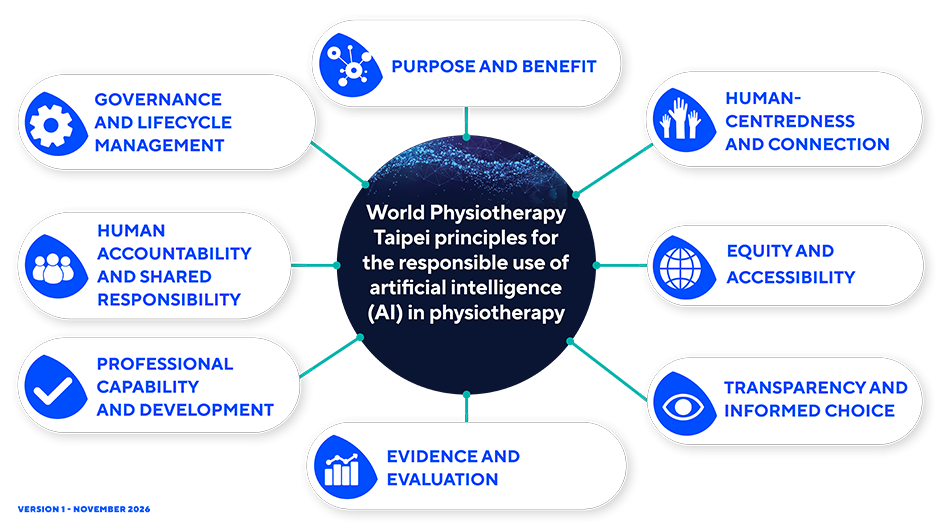
About the principles
The eight principles provide a shared foundation for considering the responsible use of AI across physiotherapy and address key aspects including equity and accessibility, transparency, professional capability, accountability, and governance
The principles do not constitute an endorsement, encouragement, or requirement for AI adoption. World Physiotherapy member organisations and individuals may use them to inform their own approaches to AI, taking account of local circumstances and relevant legal and regulatory requirements.
About the summit
The World Physiotherapy Global Summit on AI in Physiotherapy was hosted by the Taiwan Physical Therapy Association (TPTA), in collaboration with the Industrial Technology Research Institute (ITRI) and the School and Graduate Institute of Physical Therapy, National Taiwan University.
The summit received support from Taiwan's Ministry of Health and Welfare, Ministry of Foreign Affairs, and Department of Industrial Technology, Ministry of Economic Affairs.
International experts
The following international experts played a central role in developing the Taipei principles, drawing on their collective expertise across physiotherapy practice, education, and research. Their collaboration was instrumental in shaping the eight principles and ensuring they reflect a range of international perspectives.
Gabriel Alain (United States), Chih-Hsiu Cheng (Taiwan), Ya-Lan Chiu (Taiwan), Mary-Catherine Fraser (Canada), Ashley James (United Kingdom), Haneul Lee (South Korea), Desmond Mathye (South Africa), Caroline (CJ) Morrow (United States), Leo Ng (Australia), Nicolas Pinsault (France), Michael Rowe (United Kingdom), Ali Soroush (United States), Claudio Tapia (Chile), Joost van Wijchen (Norway), Kanji Yamada (Japan), Nai-Jia (Linda) Yao (Taiwan).